Long Distance Ice Skating
(updated Jan 22 2026)
There are several possible English translations of the Swedish term
"långfärdsskridsko", including tour-skating, trip-skating,
cross-country-skating, backcountry skating, nordic skating, long
distance skating, wild skating. Apparently, it is extremely popular now
in Sweden with over 100,000 skaters in hundreds of clubs, who sometimes
skate more than 100 km in a day. The longest tour in the skridsko.net
tour-report list is 240 km in 14 hours on
March 2 2011 !
The Swedish skating clubs make extensive use of the internet to
propagate information about skating, ice conditions, ice safety
techniques, etc. A lot of the skaters use digital cameras to record
their ice adventures and publish photo albums on WWW. There is a list of
skating clubs in Sweden, Finland, Norway and Netherlands, databases for
trip-reports and photos, and other links at:
Skridsko-Net (the Skating Network).
Of course, most of the articles are in Swedish. There is a description
of the Skating Network's functions on
Waves On Frozen Water
NEW(Dec 2018) Nova Scotia is now on the Skating Network map with
Nor'Easter Natural Ice:
NNI
Many municipalities in Sweden and Finland plow off long skating tracks on lakes
if they are covered in snow. These are not merely 400m ovals, but tracks
over a MIL (or "nordic mile"=10 km) long. Lakes
Runn (near Falun,
see aerial video)
and
Orsasjön
(near Mora) have ice tracks over 30 km long.
Organisers of the
Vikingarännet,
an annual 80 km long tour-race from Uppsala to Stockholm,
try to keep most of the its course, Vikingaslingan,
plowed all winter.
There are now a few plowed ice tracks in Canada and US. The 8 km
long Rideau Canal in Ottawa is the most well known. There is
a 9 km plowed track in
Joliette, Que as well as some tracks on lakes in the Laurentians.
In Fairlee, Vermont there is a 7 km plowed track on
Lake Morey,
near Nordic Skating headquarters
in Norwich.
NEW Near Radium and Invermere BC, Toby Creek Nordic Ski Club
maintains the
Lake Windermere Whiteway, 15 km (up to 30 km in a good year!) loop around the lake with
parallel tracks for XC skiing and ice skating.
Here is a photo of the
Windermere tracks.
Tour skating and marathon skate racing have traditionally been very popular
in the Netherlands, especially in the northern province of Friesland.
However, warmer winters have limited the chances of outdoor
long-distance skating. One ambitious solution to this problem
was to build a 5 km long, artificially frozen ice track! Flevonice
opened in Dec. 2007, in Biddinghuizen, Flevoland. They have a website in Dutch
at:
FlevOnice.
An English report with photos of the track is at:
trip report at Flevonice.
Another description at:
Tours and Tales:FlevOnice
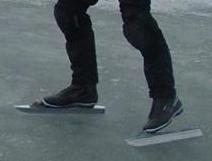
Touring skates (alias nordic skates, trip skates, long distance
skates, long reachers) have been developed for skating long distances
over natural uneven ice. They are long blades that can be attached,
via bindings, to hiking or cross-country ski boots. The bindings are
either fixed heel or free heel (like clap racing skates). Poles similar
to ski poles are used to aid in propulsion over rougher sections, but
more importantly, to test the strength of the ice. Literature in English
about tour skating is still limited but see the links below.
Since the climate and geography of Nova Scotia (and some
other areas of Canada) are very similar to that of southern Sweden,
there is a big potential for tour skating here. However, until recently,
there was almost no interest or information about tour skating here.
However, it seems that long-distance skating was fairly common in
the period 1860-1900 on the lakes and bays of the lower St. John River
in New Brunswick. Skating was a practical form of winter transportation
and there are reports of people skating on "Long Reach" skates from
Saint John to Fredericton (about 130 km) in about 7 hours! It is also
likely that the J. A. Whelpley's "Long Reach" skates were a major
development in the evolution of speed skates. See more at: Long Reach Skates .
One of the earliest writers about long distance skating
in North America was Henry David Thoreau, who often skated long distances
on the lakes and rivers near Concord, Mass. Thoreau describes his
skating tours in his journals. See:
Thoreau on skating
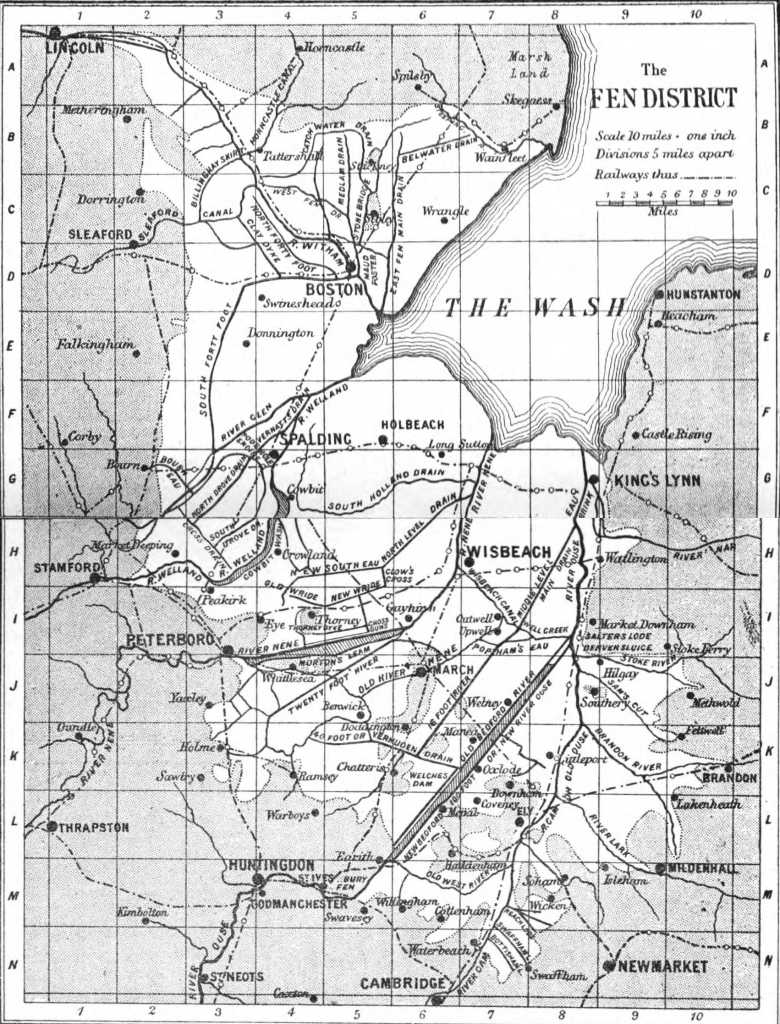
Fen Skating: Long Distance Tour Skating in England in the 1800s
Although it seems incredible now, in the nineteenth century,
recreational long distance skating (as well as racing) was practised in the Fen-lands of
Cambridgeshire!
Two books from that era that are available on OPEN LIBRARY are:
In The Goodmans' book there are route descriptions
of dozens of potential tours on the marshes and canals of the Fens.
Map of Fen District by Sidney Tebbutt
from Goodmans' book.
In "Skating(1892)",
page 204, Heathcote writes:
The longest out-and-home run that has been recorded in England was that
of Mr. C. G. Tebbutt, who, with his three brothers, Louis, Sidney, and
Arnold, skated from Earith to Wisbech and back, a distance of 73.25
miles, in 9.5 hours.
Heathcote tries to explain the addictive mystique of long
distance travel on ice on
page 202:
something more than skating at speed on a track is required for the
consummation of the pleasure. Perhaps the ever-varying condition of the
ice, a succession of new scenes and objects, the wish to have "Something
attempted, something done", and a feeling analogous to the 'cacoethes
scandendi' (the urge to climb mountains) of the Alpine climber, invest
with some romance the anticipation and reminiscences of a day's journey
over a frozen highway.
The comparison to mountain climbing is interesting, modern Swedish
enthusiasts use the metaphor "Horizontal Alpinism"!
Occasionally the possibility of Fen Skating comes again, there
were a few days of skating in 2012. There is now a 20 minute documentary
available on Youtube at:
Chasing Ice: The Story of Fen Skating
Most of my skating activity has been connected to kicksledding on
frozen lakes and there is more information in the
kicksled (spark) article.
In about 1989 I saw an advertisement in a X-C ski magazine for the
wood-base Zandstra ski-skates
but, unfortunately, I did not follow up on
it; the local "armchair experts" said something like: "They don't look
like hockey skates, so they would never work" !
Nearly 10 years later, my interest in kicksled led to the
re-discovery of this type of skates and that the fact they worked
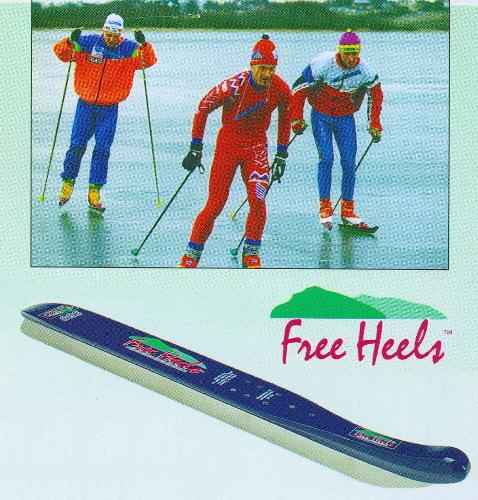
excellently. I received a photo of skate
blades, made by the Finnish company, FREE HEELS, that attached to a
XC ski boot via regular NNN or SNS ski bindings. I searched for over a
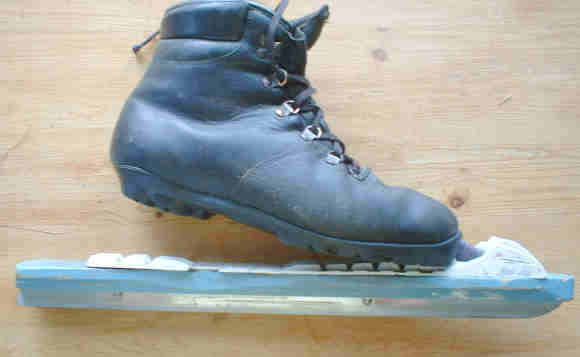
year across Canada before finding a similar model (which was the original Zandstra):
my Zandstra skates with NNN boots
I still occasionally use those wood-platform Zandstra/Steinmetz skates
although the wood is scratched up.
The model was only made for a few years around 1990. Zandstra now makes
aluminum platformed skates. But there is still a supply of the originals
available as old stock from
Nordic Skater
and
Out Your Backdoor
Pictures of:
My Almgrens
(Lundhags) skate with NNN boots and ice-claws
My Zandstra skate (wood base) with NNN boots
MULTISKATES, universal binding for hiking boots (with fixed heel)
Comparison of Almgrens and
Zandstra blades on ice
My Home-made ice-pike and tip detail.
My ice photos,(1997-2005)
mostly on kicksled, but some on skates, recent years:
winter 2005-2006
,
2006-2007
,
2007-2008
,
2008-2009
,
2009-2010
,
2010-2011
,
2011-2012
,
2012-2013
,
2013-2014
,
2014-2015
,
2015-2016
,
2017-2018
Here are some English skating links:
-
Wild Skating in North America by Jamie Hess (North American guru of Nordic Skating)
-
NEW - Nordic Ice Skating Jamie Hess's new Nordic Skating website
- NEW - Ermine Skate is
a new maker of Nordic Skates in Alaska
-
Karina Zyatitsky: Nordic Skating in Alaska and Vermont (with linked video)
-
Long Distance Skating by Timo Salmi in Finland
-
Sven-Åke Andersson (wildskating.com) describes a typical SSSK tour
, PLUS extensive information and links about tour skating in Sweden and around the world
-
SSSK(Stockholm Skating Club, the largest and oldest skating club in Sweden)
-
Mark Harris in Uppsala, Sweden
-
Skating glossary in 4 languages from LLK in Sweden
-
Lundhags now owns the Almgrens brand
-
Zandstra in Netherlands also makes nordic skates
-
The Nordic Skater Mail Order Shop in New Hampshire, main skating equipment
supplier in North America
-
Google-groups forum for tour skating in Vermont and area ,
currently the most active skating group in North America
-
Yahoo! forum for skating in Massachusetts
-
Google-groups forum for skating in New Hampshire ,
-
Yahoo! forum for Tour skating anywhere
Very inactive-
Click to join tourskate
and make it active!
-
Yahoo! forum for tour skating in Midwest USA
-
Maine Ice Sailors,
(Chickawaukie Ice Boat Club), primarily an Ice Yacht club in southern Maine, has added
nordic skating and skate sailing to their agenda.
- Facebook: Maine Ice
Facebook group for skating in Maine
-
Facebook: Nor'Easter Natural Ice Facebook group for natural ice in Nova Scotia
- NEW(Dec 2018)
googlegroup: Nor'Easter Natural Ice
private group for ice reports, trip reports in Nova Scotia
- IMPORTANT Lake Ice
: Bob Dill's articles about
features of lake ice that skaters should know about before venturing on "wild ice".
-
Skating conditions in Alaska. There is an active group of nordic skaters
in the Anchorage area, most just skate day tours on scenic routes, but a few,
like Luc Mehl and Roman Dial, do more extreme multi-day skating expeditions
in the wilderness.
-
Facebook group for nordic skating in Alaska
-
more skating in Alaska by Joe Stock
-
Alaska wilderness expedition by Roman Dial. See also
Luc Mehl's photos and video of same expedition.
-
see Luc Mehls Nordic Skate Equipment Guide |
-
Arctic Circle Skate another Luc Mehl Expedition from Dec 2019
-
Skating on Lake Morey from Yankee Magazine
- Cold Pursuit
article about Maine skater, Bob Lombardo from Down East magazine
Nor'Easter Natural Ice
Interest in skating in Nova Scotia has grown in 2018.
Joel Hornborg, a physical education teacher in Nova Scotia and "friluftsliv"
enthusiast, recently spent a year living in Sweden
and skated with long-distance skating clubs there.
He recently presented stunning videos of his skating tours.
Here are two of his articles in a local magazine:
On Solid Water
and
Nova Scotia's Natural Ice Season
A full length documentary film, "On Solid Water" is coming soon.
Nor'Easter Adventures sells skating and ice safety equipment.
Online forums for sharing natural ice experiences are on
Noreaster on Facebook
and
Noreaster(private google group)
Nor'Easter Natural Ice is now represented on Skridsko.net, the Skating Network.
Audio (MP3)
Gary Mittelholtz, a retired CBC journalist and outdoors enthusiast from
St John River Valley, New Brunswick, had a "podcast" site called Doing
Stuff Outdoors (DSO). The DSO75 and
DSO89(summary only) shows had excerpts about tour
skating. Unfortunately, Gary died tragically at an early age in March
2010. The popcast audio contents of the DSO website have disappeared. I
had saved the audio files and put them here for posterity:
DSO75/89 (MP3) file
Theoretical Ice Forecasts
These graphs from Jan-Erik Gustafsson give a estimate of potential
ice growth on lakes (Background about ice forecast graphs) :
Photo Albums from Sweden, Finland and elsewhere:
Video clips of Tour Skating
Skaters are now producing video clips of tour skating. One common
filming trick is to attach the camera to their skating pole to get shots
from high or low. A search for långfärdsskridsko on Youtube
finds hundreds of videos of varying quality and length.
Many of the trip reports on
Skridsko-net include links to videos .
Here are some
nice video clips (time in minute:seconds):
- Jakob Vikingsson, Edmonton, Alberta
-
Skating Big Lake, Edmonton, Nov 2018(1:32)
-
Skating 45 km , Maligne Lake, Jasper National Park, Nov 2020 (12:15)
- Flying on Ice
skating in Alaska and Vermont, by Karina Zyatitsky(4:56)
-
Advanced Skating technique practices by Mårten Ajne (11:37)
- Swedish skating Adventures (9:45) Guided skating tours in Sweden
- highlights of 2011/12 season with SSSK (8:22)
- Skating and skate sailing Lake Winnipesaukee, NH (7:42)
- SSSK (elite group 1) 100 km on lake Vaettern 2006 (6:16)
- SSSK 100km in Hofors lakes (5:33)
- Great skating in Dalsland (4:32)
-
Skating on Squam Lake N.H. (3:43) This skater now lives in Halifax, see his
Williams Lake(2:34) video
- Holiday on Ice(3:01) relaxed SSSK tour
- Marvikarna lakes(2:58)
- skating on Mt Desert Island, Maine (2:58)
another video from the same area:
Pushaw Lake (2:30)
-
Just a day at the lake in Maine(4:00)
- Vänern 2010 (2:41)
by Bo Gustavsson - "lacking the words to describe these wide-open spaces of ice"
- SSSK Group 1 on Kloten Lakes(2:34) Some good action shots and camera angles!
- Ice is nice(2:30)
- April 5 2009; final skate of season in Stockholm (2:27)
- Kloten-Nyfors(2:14)
- Archipelago(1:46)
-
Aerial view (drone) of skating track on lake Runn near Falun, Sweden(9:29)
-
Nordic Skating: Winter's newest edge (12:46) film by Jeff Tolbert
- From Vermont Public TV: Nordic Skating in Vermont (8:34),
interview with Jamie Hess
- TV clip of Nordic Skating on Lake Morey with Jamie Hess (3:13)
- A new Action movie?? Skating The Glass Mountains
- Early season (2014) skating on Ånnsjön
in the mountains of Jämtland on
November 7 (2:19) and
November 8 (3:03) and
even more! (4:31)
-
Highlights of a 119 km tour through Jämtland in 10 hours (3:53)
-
Coloured by skates great camera angles(3:46)
-
Oskar Karlin: 6 day Lapland expedition(18:54)(Now with English subtitles)
- Baikal(Siberia): excerpts from Gregory Kaczor's 2 week expedition:
Overview (5:28)
and
Around Olkhon Island (2:53)
- Maria Lindqvist of Göteborg skate club (GLSK)
produces artistic videos of tours on exotic lakes:
-
Nigardsbrevatnet (4:35)- blue and green ice in Jotunheimen
-
Jotunheimen-Sognefjorden (3:45)-
skating on mountain lakes and sea fjords:
Gjende, Vågåvatn, Lustrafjorden etc! (3:45)
-
Salsvatnet (3:28)-
Maria and Lars bag another trophy lake in Norway!
-
Austdalsbreen (Nov 2018) (5:36) Maria and Lars below the glaciar!
-
Jotunheimen Oct 2019 (3:19) Maria, and friends on high(+1800m) mountain
lakes in early October
- IceNrds in New England,
4 Swedish skaters come to New England USA to skate its lakes (4:47)
-
skating Palmer Hay Flats near Anchorage Alaska (4:57)
- Luc Mehl: Selawik to Kotzebue expedition, Alaska(3:01)
-
Luc Mehl: 5 day expedition, Bethel to Goodnews Bay, Alaska (4:39)
- Arctic Circle Skate (6:00)
another Luc Mehl wilderness skate
-
Wild Ice: Alaska (3:00) film by Paxson Woelber and Cale Green,
featured on National Geographic and many other sites
-
Skåne 2015-2016 season highlights in Sweden's far south (10:03)
- Femlingen Nov 13 2016 season premier in southern Sweden(6:20)
-
Nov. 2016 season premier in Blekinge by Joel Hornborg (10:06)
- 5 Lakes on the Border(Blekinge/Småland)
by Joel Hornborg, (5:53)
- sneak preview of ON SOLID WATER- part 2:
One Season on Swedish Ice; 2 excerpts from
Joel Hornborg's forthcoming documentary film
-
Season start (5:29)
-
100 km tour on Helgasjön (4:48)
- Joel Hornborg's new clips (2018-2019) for Nor'Easter Films "ON SOLID WATER"
-
West Dover Chain Lakes (4:02) near Peggys Cove, drone video by Joel Hornborg
-
Long Island Kennebcasis (2:56) Joel skates on Kennebecasis, near Saint John. N.B.
-
Grand and Ragged Lakes (4:02) near Sambro, NS (jan 5 2019)
-
sunset on Minamkeak Lake near Bridgewater (1:47)
-
LSS in Blekingen, Sweden(7:07) ,
skating with the club LSS (Long distance Skaters in the South-east)
-
Salmontail Lake Dec 8. 2019 (2:26)
- Lake Rossignol ,80 km on Nova Scotia's largest lake
-
7 Lakes on Eastern Shore (6:39) Jan 22, 2022
-
Minamkeak Lake Tour (05:37) by Paul Newton
- Krister Valtonen's "ICEMANSHIP" series
-
Icemanship Part 1: How to judge ice - (click "CC" for English subtitles) (7:50)
-
Part 2: - smalstavig kärnis - YouTube
-
Part 3 - isområdesprincipen
-
safety film from ICEGUIDE,
a company that arranges safe skating tours in Sweden (3:03)
-
safety film from GREEN TRAILS
another company that arranges tours (5:25)
-
Wild skating safety tips Safety Gear and Tips from Dan Spada (19:13)
- Norwegian Safety film
from Oddvin Lund of DNT- English sub-titles
-
Skating Safely On Wild Ice! from Maine the Way
- Erik Normark in Northern Sweden
-
early November skating (5:11)
-
Ice Skating along the River (4:44)
-
Another river skate (Nov 2019) with English subtitles ((7:11)
-
Ice Skating and Camp Fire (dec 2020) - YouTube(12:39)
- Per Sollerman, professional photographer and skater
in Oslo Skate-Touring-Group(STG):
-
A Nordic Skater: Per Sollerman (5:26)
biographic video about Per Sollerman, by Paulius Neverbickas,
featured in the 2020 Banff Mountain Film Festival
- Iskongress2019 (4:34)
showing skating action in various venues in Norway, produced by Per Sollerman
for the 2019 International Ice Congress in Oslo
-
Lars Pettersson on Iddefjorden 30 jan. 2021
(2:26) Per Sollerman films Lars Pettersson;TWO GREAT ARTISTS!
-
Wild Ice Skating In Sweden (3:10)
by Henrik Trygg, professional photographer
- Islyckan : a collection
of videos by Anne Niskala (who skated over 10000 km in the 2023-2024 season!)
- BOB - Maine Adventurer humorous documentary about Bob Lombardo (11:01)
Halifax Commons Skating Oval
Halifax now has the only long-track (400m) oval east of Quebec.
Ice Webcameras
These are links to webcameras showing ice conditions
Where to buy in Canada
Besides Nordic Skater, the following stores may sell touring skates:
Quote about tour skating from
THE SERENE BEAUTY OF BLACK ICE
by Eric Kendall, The Independent (London), Jan 16, 1999:
This magic carpet ride is quite unlike any other sensation the
outdoor world has to offer, knocking mountain-top sunsets into a
mundane second place. Nothing could come close to the ghostly calm and
gravity-defying strangeness of the lake. No wonder so many of my fellow
skaters deem it "a religious experience".
back to HOME
David Dermott
(david@dermott.ca)
Wolfville Ridge , Nova Scotia, Canada